What does a former US president have to say about AI, political division and the future of democracy? Quite a lot, as it turns out.
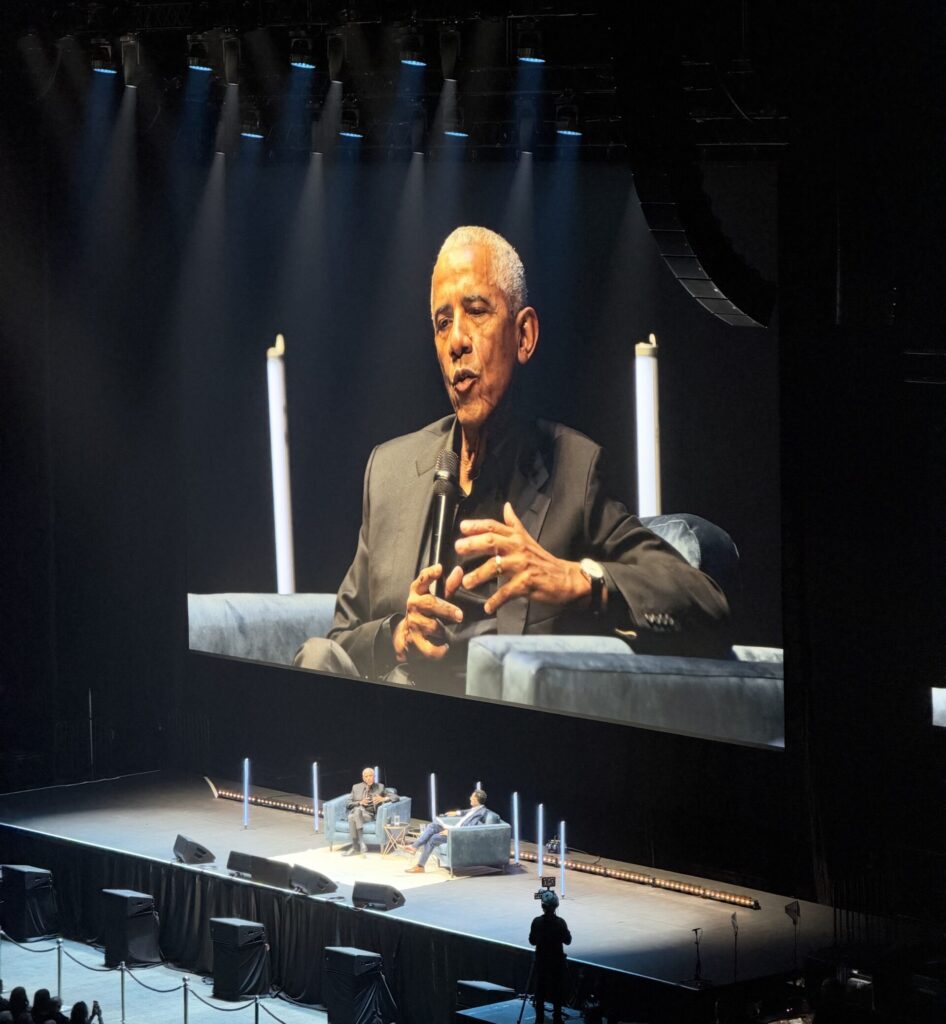
On a chilly Wednesday evening in October, Barack Obama took to the stage at Glasgow’s OVO Hydro for a conversation about leadership, politics and the challenges facing the world.
Obama was as articulate and charismatic as you’d expect, measured and ever the optimist. But anyone hoping for particularly revealing insights into his time in office, or the current political landscape, might have left wanting a little more.
Still, there were some interesting observations, particularly for those of us working in communications and public affairs.
AI, misinformation and the battle for trust
Obama warned of a vacuum in government when it comes to dealing with artificial intelligence and the challenges this creates for the next generation.
In a world where social media already makes it difficult to distinguish fact from fiction, AI is making that task harder still. For people navigating this environment, knowing what, and who, to believe will be one of their biggest challenges. And for those trying to reach them, the challenge is even bigger.
It’s a concern that goes well beyond politics. For governments, businesses and communicators alike trust is becoming harder to earn and easier to lose.
And as AI perpetually changes how information is created and shared, content grounded in integrity, authenticity and human judgement becomes more important than ever.
But trust is only part of the picture. How we connect with one another matters just as much.

Social media was supposed to bring us together. So what happened?
Reflecting on his presidential campaign, Obama recalled using Meetup, an online platform that helped supporters organise and connect.
The technology was important, but the real value was what happened offline. People from different backgrounds came together, discovered what they had in common and were exposed to perspectives they might not otherwise have encountered.
It’s an interesting contrast to the role social media often plays today, where algorithms can reinforce existing views, keeping us in our own little echo chambers rather than challenging them.
Obama’s point was a reminder that connection isn’t simply about reaching people. It’s about creating opportunities for them to understand one another.
For communicators, that’s a distinction worth remembering. We spend an enormous amount of time thinking about audiences, channels and reach. Perhaps we should spend more time thinking about what happens after we’ve reached them.
And when those opportunities for genuine connection disappear, it’s perhaps no surprise that divisions become harder to bridge.
Division and the importance of being heard
Perhaps the most interesting part of the evening was Obama’s reflection on political division.
His argument was that nobody has a monopoly on suffering or persecution. When we start comparing people’s experiences, deciding whose grievances are legitimate or only responding to those we consider most deserving, we risk alienating the very people we need to engage.
That doesn’t mean every grievance is justified, or every argument deserves equal weight. But dismissing someone’s concerns doesn’t make them disappear.
It can simply leave the door open for those with somewhat less constructive intentions, to exploit that frustration.
It’s a lesson politicians and organisations alike would do well to heed. If you want to change minds, you first need to understand why people think the way they do, then meet them where they are at.
A reason for optimism?
Despite these challenges, Obama remained characteristically hopeful about the future.
Asked whether young people were increasingly anxious about what lies ahead, he challenged the idea that today’s generation has it worse than any before it.
He pointed to progress in global health, prosperity and living standards, and argued that young people are more conscious of issues such as climate change, equality and inclusion, and more determined to do something about them than previous generations.
The biggest applause of the evening came when he suggested that perhaps the best way to support them was for “old men to get out of their way”.
It was a reminder that, despite the divisions and uncertainty, there is still a generation determined to make a difference.
Obama built his political career on the power of hope, connection and collective action. Nearly two decades after his first presidential campaign, the tools we use to communicate have changed beyond recognition. The challenge of bringing people together, however, remains much the same.
And perhaps that’s the point worth taking away, even if a few more follow-up questions wouldn’t have gone amiss.